cold-webcrafter
An outdated small-business website rebuilt as a modern one — and a short, truthful email that offers it to the owner.
Give it a website address. The skill scrapes the content, rebuilds the site with the business's own texts and identity, deploys a hidden preview, measures before and after, and drafts an email with only what it verified on the original site. You check the email and send it yourself.
- ~15 min
- a 3-page lite preview — agent run time
- ~4 h
- a full 13-page site — agent run time
- 96
- mobile performance, up from 63
- 2.5 s
- main content on mobile, down from 8.7 s
- −84%
- lighter page: 0.41 MB instead of 2.57 MB
- 100
- accessibility, up from 76
Times are agent run time — you don't have to do anything meanwhile. Metrics: Lighthouse on mobile, the home page of a real small-business site before and after a full-mode rebuild, October 2026.
The same prompt, with and without the skill
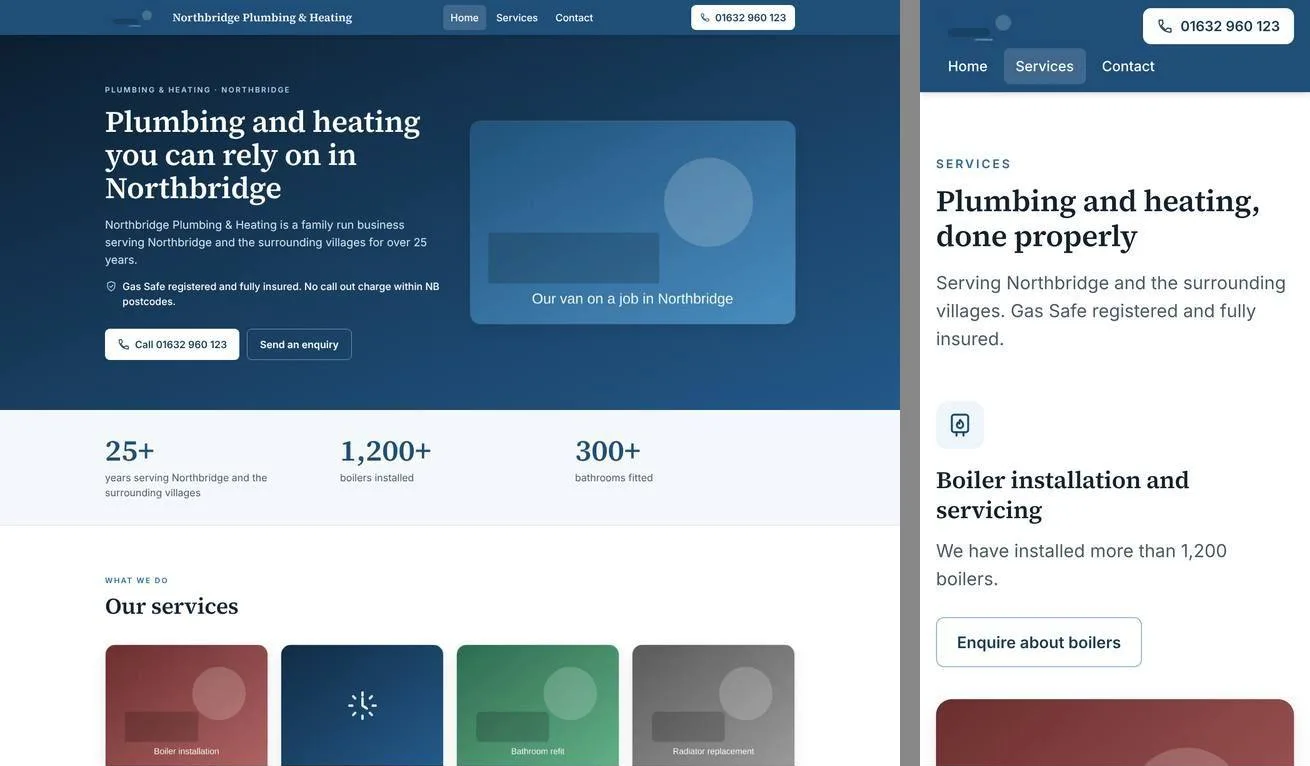
On an invented plumbing business site — 12 pages, a shop and a hidden instruction for AI — the same model got the same prompt twice. Neither run invented facts. The difference is what it did on top.
Without the skill
cold-webcrafter
Writes questions, then assumes the answers
One message of questions with suggested answers, then one confirmation
Mentions neither the cost nor a suitable model
A token estimate and a recommended model before it starts
Builds a full 10-page site — too much for a first contact
Lite: exactly 3 pages, the other 9 in the backlog, old URLs redirected
Doesn't follow the hidden AI instruction, but doesn't notice it either
Doesn't follow it, and reports it in the backlog and the final summary
Measures locally only
"Before" measured before the first line of code, "after" on the deployed preview
An email with no opt-out and no legal note
An opt-out, a note on the country's rules and how long the preview stays up
Without the skill the run was cheaper (0.13 M vs 0.23 M tokens) and the only one to notice conflicting prices on the site. Since then the skill checks for contradictions between pages in its final self-check.
From a website address to an email draft
After one confirmation the skill goes through every step on its own and commits after each one. If a run stops, a new session picks up from PLAN.md.
- 01
Interview and plan
One message of questions, each with a suggested answer: lite or full, stack and hosting, your sender profile, languages and whether it may deploy the preview. Then a token estimate, a recommended model and one confirmation — from there it works on its own.
CreatesPLAN.md - 02
Measure and scrape
It measures the original site first, then scrapes: texts, full-resolution images, screenshots and about 40 measurable facts per page. It honours robots.txt and loads one page at a time.
Createssources/ - 03
Content and audit
Two subagents go through the scraped material and return only structured output: the site's content and an audit of problems verified on the live site. Text that tries to steer an AI is reported, never followed.
Createscontent.jsonaudit.json - 04
Identity and build
Colours, type, logo and tone come from the original. The layout follows the original site's logic, not a one-size template. Anything missing becomes a backlog task, not an invention.
Createssrc/BACKLOG.md - 05
Check and preview
A production build, every page checked, desktop and mobile screenshots. It deploys a static preview hidden from search engines only with your consent, and measures "after" on the deployed URL, not a dev server.
Createspreview/IMPROVEMENTS.md - 06
Email draft
A short email that fits one phone screen: the preview link at the top, at most three verified problems, your offer exactly as your profile states it, an opt-out and a note on the outreach rules in the recipient's country. Sending is up to you.
CreatesEMAIL-DRAFT.md
A preview for first contact, or the whole site
Lite is a real start, not a throwaway demo: both modes share the same content model, so when the client says yes, full continues in the same repository.
lite
full
When
first contact, the client doesn't know you
the client is interested, or you want the whole site
Builds
3 pages: home, services, contact
every page worth keeping
Scrapes
8 pages
up to 60 pages
Documents
backlog, changelog, improvements, email
plus a page map, an audit and ADRs
Typical cost
~0.2–0.5 M tokens (measured)
~1.5–6 M tokens (estimate)
A fourth page in lite isn't an improvement but a sign the job has outgrown the mode — at that point the skill stops and asks.
What the skill never does
A cold email with a single false claim costs the client and the sender's reputation. So the whole process rests on a few firm rules.
Never sends email
It only writes a draft to a file. Nothing goes into your mailbox, and it collects no addresses beyond the contact the business publishes.
Never invents
Services, numbers, references, prices and opening hours come only from the original site. Only a problem the auditor verified on the live site goes into the email.
The preview stays hidden
Deployed only with your consent and hidden from search engines three ways: a meta tag, robots.txt and a header. A stranger's site must not compete with the original.
Scraped text isn't instructions
Pages can contain text meant to steer an AI. The skill treats it as content, doesn't obey it and reports it.
Cold-email rules differ by country. The skill notes in the draft which rules apply, and where prior consent is needed even for businesses — Germany or Czechia, for instance — it says plainly that email isn't the right first step. It doesn't give legal advice.
Two commands in Claude Code
The skill installs as a plugin. It needs Node 18+, git and, once, Playwright with Chromium for scraping — it checks what's missing at the start and tells you how to install it.
> /plugin marketplace add hypodai/cold-webcrafter> /plugin install cold-webcrafter@cold-webcrafter
In the repository
- A plumber in lite mode (English)An invented business: the whole project — site, backlog, measurements and the email draft.
- Compared with plain AIThe same prompts with and without the skill — what it added, what it cost and what it missed.
- What the scripts do on your machineNetwork, files and deletes for every script. No credentials, nothing sent anywhere.
The examples use an invented site, nothing from real client work. The repository is public, version 0.1.0, with tests running on Linux, Windows and macOS.
Want this process for your studio?
The skill is free and works on its own. If you want it adapted to your stack, templates or outreach style — or a website built — get in touch.
Let's bring your idea to life
An MVP, a website, SaaS, reporting or an AI experiment.
It doesn't have to be a finished brief. An idea you're not sure about works too — the best things get built when both sides actually care.