MaržiPán
A café that finally knows what actually earns — AI reads the invoices and guards the margin of every recipe.

My own SaaS for cafés, bakeries and patisseries that make their own products. Ingredients are 40–60 % of their costs, and when butter or flour goes up, the owner finds out at the end of the month — if at all. MaržiPán watches it for them: upload an invoice from any supplier, a PDF or a phone photo, and the AI pulls out the items and prices, matches them to ingredients and recalculates the margin of every recipe. When a margin drops below your threshold, you get an e-mail.
The scope is narrow on purpose: ingredient costs, not full accounting or payroll. That's why it needs no implementation and can cost a fraction of food-service finance platforms. The MVP is being validated with a design partner — an operator of cafés that bake their own.
The problem it solves
Prices change quietly
A supplier raises prices by a few percent, the recipe is still costed at the old price, and the cake sells at a loss. Nobody sees it until the monthly result arrives.
Nobody retypes invoices
Every supplier has a different template — Money S3, POHODA, FlexiBee, a printer scan, a cash-and-carry receipt. Nobody retypes them into Excel regularly.
The till won't guard the margin
Point-of-sale systems know the recipes, but they can't read an invoice from any supplier and won't speak up when a margin drops.
How it works
- 01
Uploading a document
PDF, JPG or PNG up to 10 MB. Gemini first tells whether it's an invoice or a receipt and picks the path accordingly — a faded phone photo of a receipt needs more tolerant processing than a PDF invoice. The second path runs only as a fallback when the first extracts nothing.
Gemini 2.5 FlashZod - 02
Two models, one check
Mistral OCR turns the document into text and Mistral Small structures it; in parallel Gemini reads the document directly. The results are compared with a weighted agreement score, and the line items must add up to the total. When agreement is low, the document goes to review instead of straight into the data.
Mistral OCRPromise.allSettledAgreement scoring - 03
Matching to ingredients
Deterministic fuzzy matching — diacritics stripped, substrings, word overlap, a 0.70 threshold — with no AI call per invoice line. The app learns aliases: once "BIO RAC KUK CHL" is matched, it matches itself next time, even from another supplier.
Fuzzy matchingAlias learning - 04
Confirmation and recalculation
The ingredient price changes only after confirmation — a pack of 30 eggs for 198 CZK is not the price per egg. Then the margins of every recipe that uses the ingredient are recalculated.
- 05
The alert
Below the threshold (35 % by default) an alert is raised and an e-mail goes out. A misread price can be flagged — it disappears from the price history, the charts and the alerts, and the margins are recalculated.
Resend
What else it does
Daily closing reports
A photo of the till's closing report goes through the same two-model check. Sales are compared against plan and the day's margin is estimated; with per-product data it computes the exact margin of each recipe. A connection to the Dotykačka till is ready behind an adapter, on test data for now.
Sales planning
Per day, week or month: instant revenue, gross profit, average margin and a shopping list as CSV. Plan versus actual by recipe, and a prefill from the last seven days.
Allergens
AI proposes a recipe's allergens from the 14 in EU Regulation 1169/2011, but they apply only after manual approval — the operator is responsible for labelling, not the model.
MaržiBot
A chat over your own data: "Which ingredient do I use in the most recipes?" The model writes no SQL — it calls a set of read-only tools scoped to your business and builds the answer from the result. A daily message cap keeps the cost down.
What sets it apart
An invoice from anyone
Not a link to one point-of-sale system but any Czech invoice or receipt, even a phone photo. Czech VAT and formats are the default, not an add-on.
It speaks up on its own
Instead of a report you have to open, an e-mail lands the moment a margin drops — before a whole month is lost.
The data can be fixed
A wrong record in a till system can spoil the charts for good. Here an error is flagged with one click and its impact disappears from every calculation.
Narrow scope, low price
Only ingredient costs, not a full P&L. No implementation — the target price is a fraction of food-service platforms at 10–15 thousand CZK a month.
Technical design
Every major decision is written down as an ADR — from the choice of models to why prices are never overwritten automatically.
Next.js, Supabase and Drizzle
The App Router with server actions, Postgres on Supabase in Frankfurt and typed queries through Drizzle ORM. Hosting on Vercel, e-mail through Resend.
Tenant isolation
Row Level Security in Postgres with defence in depth: the business assignment can't be changed from the client — both a policy and a database trigger guard it. Chat tools take the business from the session, not from the model's output.
Long OCR without queues
Reading an invoice takes 15–45 seconds, and on the Vercel Hobby plan a server action is limited to 10. The upload therefore stays a fast server action, and OCR runs in its own API route with a 60-second limit — without background jobs the MVP doesn't need.
Anonymous market comparison
An ingredient's price against the median of other businesses — only when at least three others record it, and nothing but the aggregate leaves the server. Ready, and it switches itself on as more businesses join.
A closer look
What the MVP does
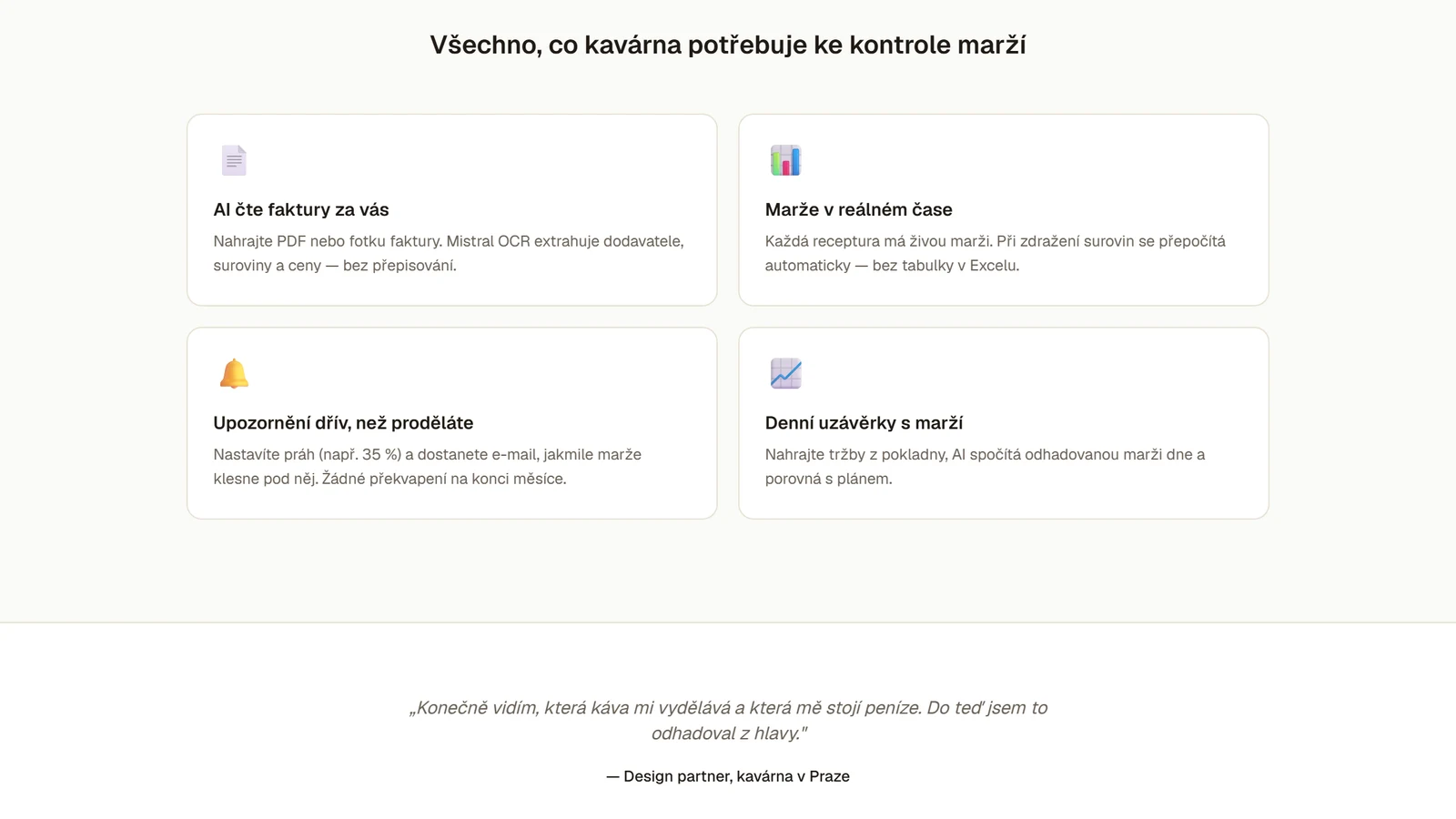
Four pillars: the AI reads the invoice, margins recalculate on every recipe, an email lands when one drops below your threshold, and the daily close compares the day's estimated margin against plan.